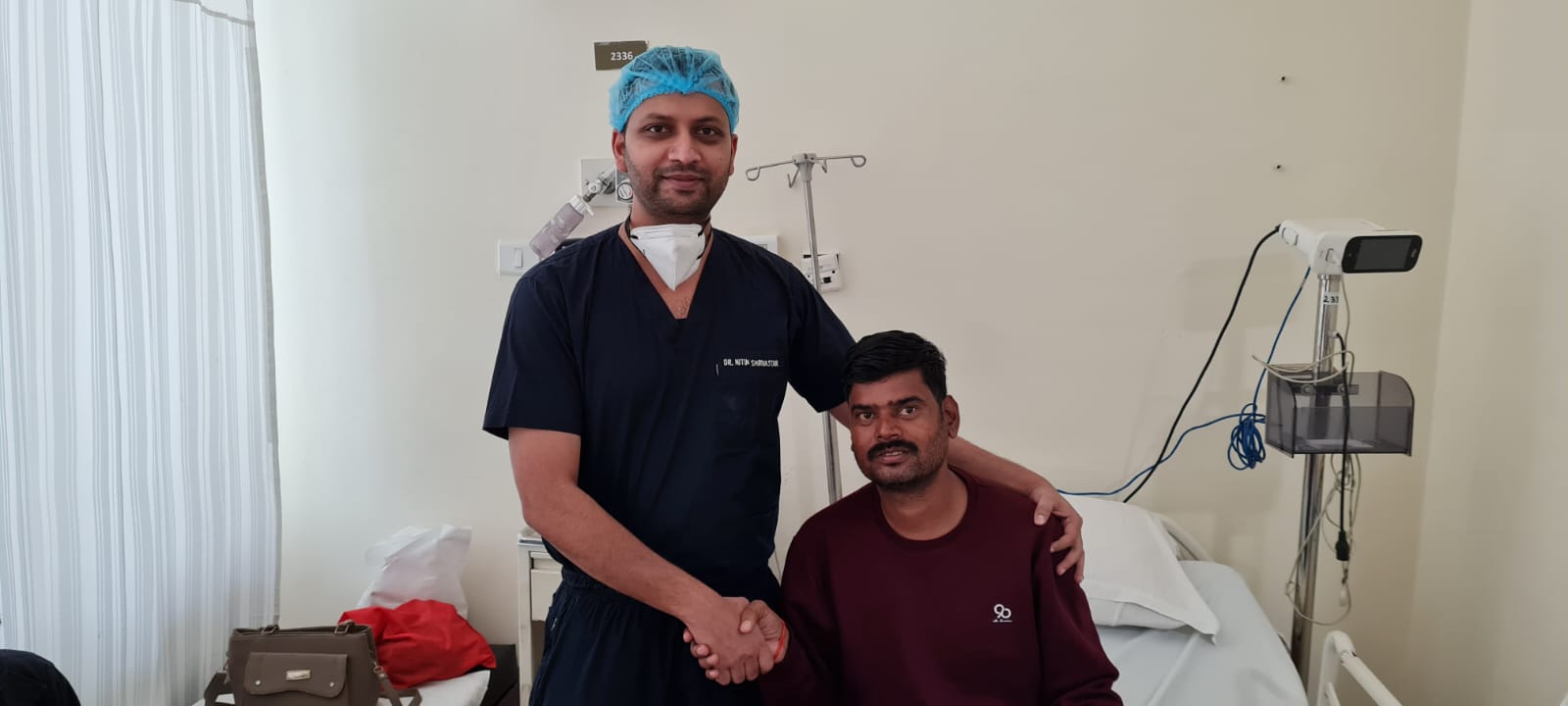
Patient story · Recurrent stones
"Three stones in two years. Dr. Nitin didn't just remove the latest one - he sent me for a stone analysis and a 24-hour urine test, and put me on a diet protocol. No new stones in 18 months."
Kidney stones · Gurgaon
If your kidney stone is causing the pain often described as worse than childbirth - or if your stones keep returning - you are on the right page. Dr. Nitin Shrivastava treats kidney stones at Apollo Hospital Gurugram and Six Sigma Clinics, Sector 50. MCh AIIMS Delhi · FRCS Oxford University, England · 15+ years · 5★ on Google.
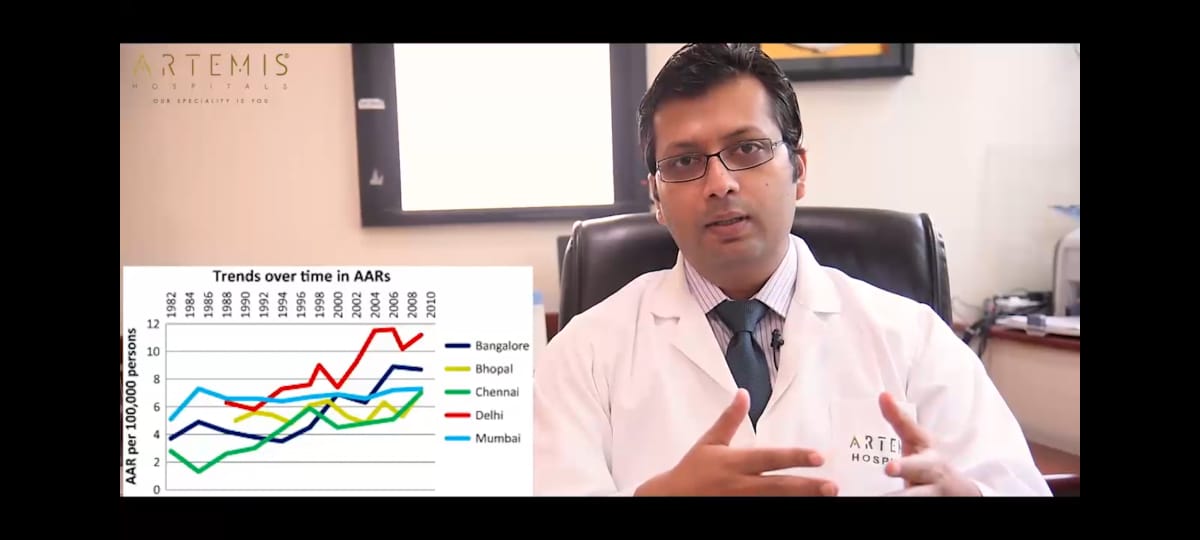
Dr. Nitin Shrivastava treats kidney stones at Apollo Hospital Gurugram and Six Sigma Clinics, Sector 50, Gurgaon. With MCh Urology from AIIMS Delhi and FRCS Urology from Oxford University, England, he is one of India's most credentialled specialists for kidney stone disease, offering RIRS (flexible-scope laser surgery), PCNL (mini-percutaneous surgery) and ESWL (shockwave therapy), with same-day consultation available via WhatsApp on +91 78382 86336.
Kidney-stone pain is sudden and disabling. It usually starts in the loin or lower back and radiates around to the groin. It comes in waves. Nausea and vomiting are common. The first time it happens, most patients think they are having a heart attack, an appendicitis, or - for women - a gynaecological emergency. It is none of those. It is a small mineral stone sitting in the ureter, the narrow tube that drains urine from kidney to bladder, and the body is trying to push it down.
The frustrating part is the inconsistency. The pain is severe - but the cure is often small. A 6 mm stone that has caused two days of agony can be removed in a 45-minute day-care procedure with no external cuts. A larger stone that has gone unnoticed for years can sometimes be left alone. A stone that has come back three times is not bad luck - it is a metabolic pattern that hasn't been investigated.
What we do at Apollo Hospital Gurugram is two things at once: treat the stone you have now, and find out why it formed so that the next one doesn't. That second part is what most stone treatment in India skips entirely.
Decision tool
A rough guide based on size and location. The actual recommendation depends on stone density, your anatomy, infection status and a few other things - but this helps frame the conversation.
Reference: 4 mm ≈ rice grain · 8 mm ≈ peppercorn · 15 mm ≈ pea · 25 mm ≈ a 5-rupee coin
Understanding the disease
A kidney stone is a hard crystalline deposit that forms when minerals in concentrated urine clump together. The four main types are calcium oxalate (the commonest in India by far), calcium phosphate, uric acid, and struvite (infection-related). Each type has a different cause, a different treatment, and - crucially - a different prevention strategy.
"Stone analysis" - sending the stone you pass or have removed for chemical composition - is one of the most useful tests in stone disease, and one of the most under-used in India.
In India, three factors push the disease above Western rates: hot weather (concentrated urine), inconsistent fluid intake, and dietary patterns high in oxalate and animal protein. Genetics matter - if a parent has had stones, your lifetime risk is roughly doubled. Anatomy matters too: horseshoe kidney, ureteropelvic junction obstruction and similar variants predispose to stone formation regardless of diet.
Symptoms
Fever (above 38°C) with flank pain. Pain not controlled by oral painkillers. Inability to pass urine. Pregnancy with sudden flank pain.
Visible blood in urine (haematuria) - even without pain. A solitary kidney with new pain.
Severe one-sided back or loin pain coming in waves. Nausea and vomiting with the pain.
Burning or frequency that hasn't responded to antibiotics. Cloudy or smelly urine.
Vague, recurrent back ache attributed to gym or posture. Recurrent UTI in a non-pregnant adult - particularly men.
Incidental ultrasound finding of "small stone" with no symptoms - still warrants a plan.
The gold-standard test for stone disease is a non-contrast CT KUB (also called a CT urogram without contrast). It detects nearly every stone, tells us the exact size, location and density (in Hounsfield units - which predicts whether ESWL will work), and assesses whether the urinary system is obstructed. It uses a low-dose radiation protocol.
An ultrasound is reasonable as a first step - particularly in pregnancy or in children where avoiding radiation matters - but it can miss small stones and underestimates size. We don't rely on ultrasound alone for surgical planning in adults.
Blood work usually includes: creatinine and eGFR (kidney function), serum calcium and uric acid, and - if infection is suspected - a urine culture before any procedure. For patients with recurrent stones, we add a 24-hour urine collection and a metabolic profile.
Treatment options
| Approach | Best for | Stone-free rate | Recovery | Notes |
|---|---|---|---|---|
| Watch & pass | < 5 mm, no obstruction, no infection | ~80% pass naturally | Days | Fluids, Tamsulosin, painkillers. Re-image at 4 weeks. |
| ESWL - shockwave | 5–10 mm, soft stones (HU < 1000), no obstruction | ~60–70% single session | Same day home | No anaesthesia or cuts. May need 2–3 sessions. |
| RIRS - flexible scope + laser | 5–20 mm, stones at any location | ~90%+ in expert hands | 1 day in hospital · 3–4 days off | Day care. Temporary DJ stent for 1–2 weeks. |
| PCNL / mini-PCNL | > 20 mm, staghorn, hard stones, complex anatomy | ~90–95% in single sitting | 2–3 days in hospital · 2 weeks off | One small flank puncture. Gold standard for large stones. |
| Open surgery | Essentially obsolete | - | - | Not used at Apollo Hospital Gurugram for routine stones. |
HU = Hounsfield units, a measure of stone density on CT. DJ stent = double-J ureteric stent.
The trained-at-AIIMS-Delhi piece of this is the technical confidence. The MCh Urology programme at AIIMS handles staghorn stones, complex bilateral disease, and stones in pregnancy at volumes that most centres see once a year. The trained-at-Oxford piece is the structured approach - clinic protocols built around contemporary EAU (European Association of Urology) guidelines, careful pre-operative planning, audited outcomes.
For routine stones, that means: a CT review before surgery is offered, an honest discussion of all three options (ESWL/RIRS/PCNL), the recommendation explained in plain language, and a clear plan for after - including stent removal and a recurrence-prevention plan based on stone analysis.
For complex stones - staghorn, bilateral, stones in solitary kidneys, recurrent stones in young patients - the approach changes. We arrange a full metabolic workup before any surgery is planned, because the surgical fix is meaningless if the underlying cause is left untreated.
"A stone that comes back is not a stone problem. It is a metabolic problem with a stone as the symptom. Treating only the stone is treating only the symptom."
Recovery
The honest picture, day by day, for a routine RIRS at Apollo Hospital Gurugram. The surgery itself takes 45–90 minutes under spinal or general anaesthesia. You'll be in post-op recovery for an hour, then back to the room. Most patients eat dinner that evening, walk to the bathroom on their own, and are discharged the next morning. There are no external cuts to dress or care for.
The DJ stent is a soft, hollow plastic tube placed through the urinary tract to keep urine draining freely while the kidney recovers. It is essential - without it, swelling at the surgical site can block urine and cause severe pain - but it is not painless.
Roughly half of patients feel a dull ache in the lower abdomen or a sensation of needing to urinate urgently for the first week. Burning during urination, occasional pink urine, and discomfort with vigorous activity are all common - none of these mean anything is wrong. The stent is removed in a brief OPD procedure (90 seconds, no anaesthesia in adults) usually at 10–14 days, and the discomfort settles within 48 hours of removal.
Office work is reasonable from day 3–4 if it doesn't involve heavy lifting. Driving is fine from day 5 once stent discomfort settles. Long-haul flights and gym workouts wait until after the stent is out. Sexual activity can resume once stent discomfort is gone - typically two weeks. Most patients are back to fully normal life within three weeks of surgery.
PCNL recovery is similar in shape but longer. Hospital stay is typically 2–3 days; office work resumes at day 7–10; full activity at three weeks. There is one small skin incision in the flank that heals into a barely-visible scar. A nephrostomy tube (a small drain) may stay in for 1–3 days depending on the case.
Warning signs that need a phone call. Most post-operative stone-surgery recoveries are uneventful, but a handful of symptoms warrant immediate contact. Fever above 38°C - even without other symptoms - needs to be reported the same day, as it can indicate an infection that has tracked back from the urinary tract to the bloodstream.
Heavy red blood in the urine (as opposed to the expected pink tinge), inability to pass urine for more than 6 hours, severe pain not controlled by your prescribed analgesia, or persistent vomiting are all reasons to call +91 78382 86336 rather than waiting for the next appointment. We would rather hear from you and reassure you than have a small problem become a hospital readmission.
The standard kidney-stone story - moderate stone, healthy patient, straightforward surgery - accounts for most of what comes through the OPD. The cases that get sent across India for specialist opinion tend to fall into one of five categories, and each needs a different approach.
Stones in pregnancy. Pregnancy changes everything. Imaging is restricted to ultrasound or low-dose MRI; ESWL is contraindicated; medication choices are narrow. Most pregnant patients with stones can be managed conservatively until delivery, but when intervention is needed, ureteroscopy with laser is the safest option and Dr. Nitin has performed this in multiple trimesters with good outcomes for mother and baby.
Stones in a solitary kidney. The stakes are higher when there is only one functioning kidney. Decisions are made with the nephrology team. Surgery is offered earlier (a stone obstructing a solitary kidney is a medical emergency), and we lean towards the technique with the lowest risk of bleeding or further kidney damage - typically flexible ureteroscopy over PCNL where possible.
Bilateral stones. Stones in both kidneys at the same time are typically staged. We operate on the more obstructed or symptomatic side first, allow 2–4 weeks for recovery, then address the other side. This is gentler on kidney function than doing both in one sitting.
Staghorn stones. Staghorn calculi fill the entire collecting system of the kidney and look on imaging like a deer's antlers. They are almost always associated with infection, and untreated they progressively destroy kidney function. PCNL is the standard, sometimes in combination with flexible nephroscopy or staged ESWL for residual fragments.
Recurrent stones in young patients. If a 25-year-old has had three stones already, something specific is driving it - and standard advice ("drink more water") will not be enough. We arrange a full metabolic workup: stone analysis, 24-hour urine collection, serum calcium, parathyroid hormone, vitamin D, and screen for primary hyperparathyroidism, distal renal tubular acidosis, primary hyperoxaluria and cystinuria. The treatment then targets the specific defect.
Patient story · Recurrent stones
"Three stones in two years. Dr. Nitin didn't just remove the latest one - he sent me for a stone analysis and a 24-hour urine test, and put me on a diet protocol. No new stones in 18 months."
Video Education
From diagnosis to stone-free - understand every treatment option
Kidney Stone Treatment Options
Kidney Stone Prevention & Diet Tips
FAQs
The classic kidney-stone story is sudden, severe pain in the loin or lower back that radiates to the groin, often with nausea, vomiting, and visible blood in the urine. The pain is famously described as worse than childbirth. But not all stones cause pain - many are discovered incidentally on ultrasound during health checks or pregnancy. If you have had unexplained one-sided back or flank pain, blood in the urine, or recurrent urinary infections, a non-contrast CT KUB is the gold-standard test and Dr. Nitin will order one if appropriate.
Stones smaller than 5 mm have a high chance of passing naturally with increased fluid intake, an alpha-blocker like Tamsulosin, and adequate pain control. Stones between 5 and 10 mm pass spontaneously in roughly 50% of cases - the rest need help. Stones above 10 mm rarely pass and almost always need treatment. Location matters too: stones in the lower ureter pass more easily than stones higher up. A CT KUB tells us size and location precisely.
The right treatment depends on stone size, location, density, your anatomy and whether infection is present. As a rough guide: ESWL (shockwave therapy from outside the body) suits small to moderate stones with no obstruction; RIRS (flexible scope through the urinary tract + holmium laser) suits stones up to about 20 mm and is the workhorse procedure in modern stone surgery; PCNL (small flank puncture) is reserved for large stones, staghorn stones, and complex cases. Dr. Nitin will review your CT and explain the trade-offs before recommending one - including the recovery and the realistic stone-free rate of each option.
After RIRS, most patients are discharged the same evening or the next morning and back to office work within 3–4 days. A double-J stent is usually placed for one to two weeks, which is removed in a brief OPD procedure. After PCNL, hospital stay is typically 2–3 days, with full activity by 2 weeks. Strenuous activity and heavy lifting are avoided for about 3 weeks. Dr. Nitin will give you exact, personalised timelines after surgery.
Recurrence is not bad luck - it is the result of an underlying pattern. After the first stone, we typically arrange a stone analysis (the stone itself is sent for chemical composition), a 24-hour urine collection, and a metabolic blood panel. The results drive the prevention plan: fluid targets (aim for clear-pale urine), a diet protocol adapted to Indian eating patterns (oxalate, sodium, animal protein, calcium balance), and - in some cases - medications like potassium citrate or thiazides. Patients on a proper prevention protocol see recurrence rates drop dramatically.
A small, non-obstructing stone in the kidney is generally not dangerous in the short term. A stone that obstructs urine flow is - it can cause infection (which can be life-threatening if combined with fever and not promptly drained), and over weeks to months can permanently damage kidney function. Stones with fever are an emergency. Stones with rising creatinine need urgent attention. Asymptomatic stones still warrant a plan, even if not immediate surgery.
Yes. ESWL involves no incisions at all - shockwaves are delivered from outside the body. RIRS involves no external cuts either - the scope passes through the natural urinary tract. PCNL involves one small puncture (under a centimetre) in the flank. Open stone surgery is essentially obsolete in modern urology and is not used at Apollo Hospital Gurugram for routine stone disease.
Indicative costs for kidney stone surgery at Apollo Hospital Gurugram, in 2025 rupees. These are package ranges - the exact quote depends on stone size, expected complexity, room category, and whether bilateral surgery is planned. We give every patient a written estimate before any procedure, so there are no surprises.
Most major Indian health insurance is accepted at Apollo Hospital Gurugram on a cashless basis - including Cigna, ICICI Lombard, Star Health, HDFC Ergo, Bajaj Allianz, Aditya Birla, and MediBuddy/Vidal corporate plans. Pre-authorisation is handled by the hospital insurance desk; we provide the clinical justification letter and the team coordinates approval. CGHS, ECHS and most TPA panels are also empanelled.
Related
Day-care laser stone removal - the workhorse modern procedure.
Read →For large and staghorn stones - small flank puncture, high clearance.
Read →Practical eating protocol for the Indian kitchen.
Read →Visual ruler to understand your CT report.
Read →Book a consultation
Share your concern below. Our team responds via WhatsApp or call on the same working day. For surgical second opinions, please attach your reports during the WhatsApp conversation that follows.

